
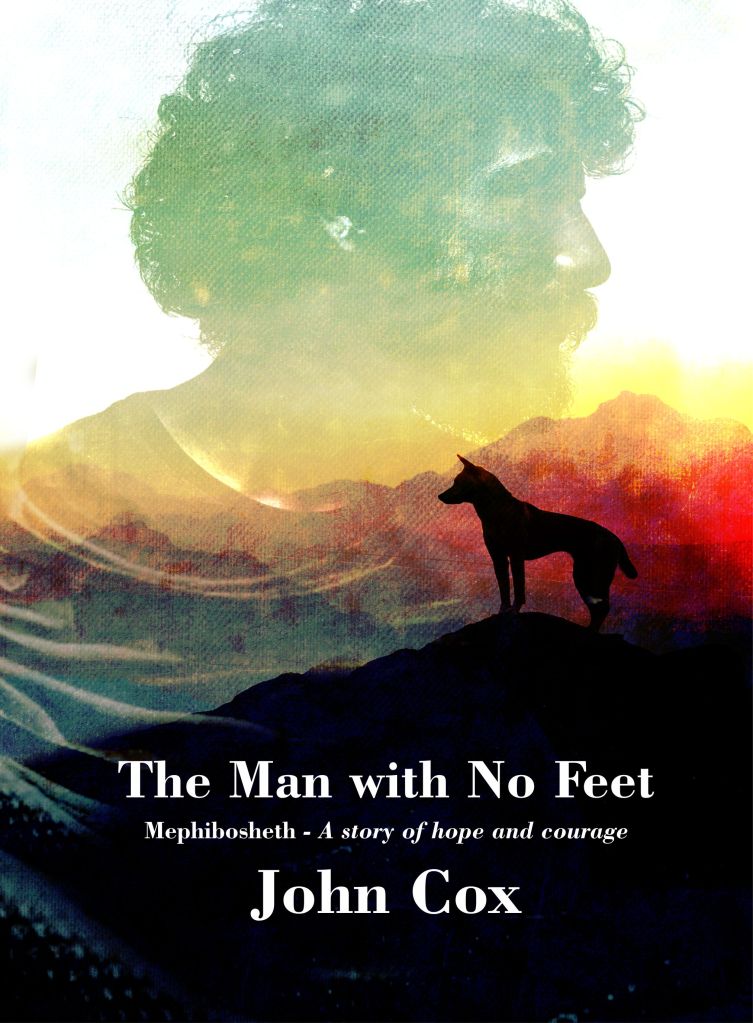
The Man With No Feet Mephibosheth, A Story of Hope and Courage.
Now also available on audio: https://www.audible.ca/pd/The-Man-with-No-Feet-Audiobook/B0DBJGQ9SM
This is a story of struggle, character, and life being unfair. It is about resilience and courage. Not every prayer is answered, but some are profoundly so. It is about a life lived 3,000 years ago, yet it could have been yesterday!
Mephibosheth lived around the beginning of the 10th Century BC. His father was Jonathan, a great friend of the future King David and the grandson of King Saul. When his grandfather and father died in battle, the shock was overwhelming. The caregiver dropped the little boy of five years old. This incident rendered him crippled in both feet. His family fled in fear to a remote village called Lo Debar. Eventually, King David remembered his covenant with Jonathan and restored Mephibosheth to Jerusalem, where he lived in the palace.
Very little is known of Mephibosheth from Biblical history. We know that he lived during the rise of the new city of Jerusalem. He lived in the palace of David. Undoubtedly, he witnessed the building of Solomon’s Temple. He would have known of David’s adultery with Bathsheba, his songs and psalms, and the challenges to his power from his son Absalom and others. How did this man, falling from prince to pauper, from able-bodied to a cripple, then restored to the king’s palace, navigate such a turbulent journey?
This is the imagined story of Mephibosheth’s life and times. A life overcoming disappointment with courage, hope, and faith.

Here’s an interview with myself.
Why Mephibosheth?
I’ve always been intrigued and inspired by Mephibosheth despite how little is recorded in the bible about his life. He was born a prince, lost his father and grandfather at a very young age, was crippled, fled into obscurity as a refugee to Lo Debar, and was unexpectedly restored to the palace by King David. There must be an interesting story there.
How much of what you have written is true?
The bare bones bio and geographic region are rooted in history. I have imagined the family members around Mephibosheth, of whom there is no historical record. We know nothing of his mother, his wife, or whether he had children. He lived through historic and turbulent times, including the reign of three major kings of Israel, and would have had personal relationships with all three.
Do you have any personal knowledge of the region?
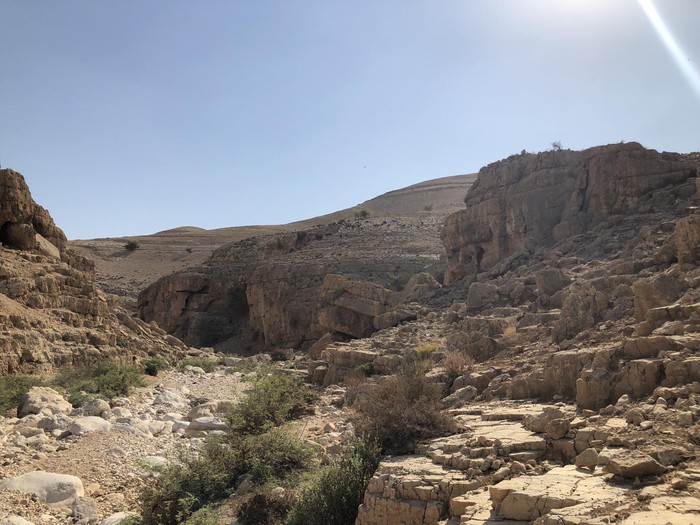
Yes, I spent five weeks studying and travelling around Israel, which allowed us access to more than just tourist locations. I lived in Jerusalem and visited the Jordan Valley, the Galilee (Kinnereth, as it was known) area, the deserts, and the wadis (river valleys). I hiked down the wadi Mephibosheth would have used to travel between Jerusalem and Lo Debar.
What relevance does this story have for a reader today?
Mephibosheth’s story has universal themes: sudden tragedy and loss, circumstances changing beyond our control, and insecurities in childhood. He battled with despair and negative voices in his head; life seemed very unfair at times, and hope was hard to come by as he knew he would never walk again. How does one cope with adversity? Where is God? Will I ever find fulfilment and joy again? It’s a contemporary story lived three thousand years ago. Human beings are the same throughout the ages.
How was Mephibosheth’s world different from our culture?
This is probably how we tend to compartmentalize life today in the West. In Mephibosheth’s time, faith and everyday life were intermingled. Their identity as a nation and a people who followed Yahweh/God informed every facet of life. They could never have imagined life without Yahweh, however simple or unsophisticated that understanding may have been. Today, such integration of life and faith is found in parts of Africa, the Middle East, India, and other world regions. Something rich, beautiful, and deep often nestles in an integrated worldview.
Are there any surprises in your research and writing?
I’m fascinated by human behaviour generally. Particularly when Christianity, or religion, gets hold of historical figures, they tend to be presented as over-spiritualized and sanitized. This means that from the readers’ perspective, biblical figures are distant and unreal and have characters that seem too good to be true. That evokes the understandable response: “I can never be good enough or like that, so why bother?” A significant group of biblical figures would have been thrown out of churches today and certainly barred from leadership. I have always appreciated diving below the surface and attempting to discover and appreciate every human character’s good, bad, and ugly facets. If God never lifts his hand from them, then there is hope for me. That’s encouraging!
Mephibosheth is not perfect, and neither are his story’s main characters. King Saul and King David are deeply flawed, with mental health issues, moral breakdown, cruelty, and glaring inconsistency in their personae. Saul becomes insane with tragic outcomes for his nation and family. David’s inability to be a good father is a major issue; he favours Mephibosheth, yet cannot relate with his children. It leads to family dysfunction and tragedy (sadly, a true part of the story). This underscores the mysterious reality that there is no guarantee of an easy life merely because someone serves or believes in God.
And yet, there is something redemptive in the story.
Yes, the hope woven through the lives of these characters springs from the nature of God to redeem. He does not abandon people who don’t deserve second or third chances. He is much kinder and more empathic to human frailty than most comprehend. In our culture, people who fail or make mistakes are judged, discarded, and regarded as disappointing and untrustworthy in politics and the church. In contrast, God never gives up on anyone and always provides a new opportunity, provided the individual is willing to own their stuff and move on. Mephibosheth is not a solitary individual. He is part of a community and is always loved with a healthy sense of interdependence. Sadly, we have become a society of individuals and individualism, and we pay the price. Everyone needs a supportive community, particularly when life is turned upside down. Mephibosheth’s life illustrates some of these themes. He could never have found hope and rebuilt his life without God expressed through community.

Are there any other themes for hope?
Mephibosheth lived in fear and dread for much of his early life. His worst nightmare of being killed by David was never realised. Instead, the opposite was true. The person he most feared became his friend. Gradually, he grew to accept himself. He found meaning and identity that transcended his limitations and the temptation to define himself as a man crippled in both feet. He overcame his inner demons and became so much more than someone with a disability in the eyes and hearts of those who loved him. That inspires me, and I hope encourages those who read his story.
Last question. What delights you as you write?
That’s easy. The uncertainty, the challenge, the not knowing whether anything will come together on the pages. But probably most intriguing is how the first little stick figures of people become personalities, increasingly alive, and eventually friends. So that when the end is finally reached, it’s hard to say goodbye.

A Few Book Reviews:
John’s portrayal of Mephibosheth is inspired. He has given this almost unknown man a personality we can relate to. I had a hard time putting the story down. It is easy to get into this narrative exploring Mephibosheth’s struggles with his physical handicap, his self-worth, and all the emotions and life events that aren’t mentioned in scripture but are realistically imagined. He is an example of fortitude and how the support of others builds emotional and spiritual strength.
Ken Seegmiller
This is a beautiful book. John Cox masterfully weaves a tale of real wisdom from an unfamiliar biblical story. This wisdom is not just for the characters in the book but for all of us as we navigate our shadow experiences, be they relational or circumstantial.
David Cooke
Mephibosheth is a huge work of biblical fiction, a very entertaining book I enjoyed reading. It takes place at a most interesting time: during the reigns of the great kings of Israel, King Saul, David, and his son Solomon. I was amazed at the fine details in relationships, place names, language, and events providing great authenticity. This wonderful historical novel beautifully paints the spaces between scripture in fine colours and layers. I learned greatly from the culture and customs of that time and mostly from the life lessons that can be applied to each of us today.
Walter Kusmin

Where to Purchase?
The Man With No Feet is available on Amazon as a paperback or an E-book. (Audio Book now complete).



 Googling God
Leave a comment