
Nothing comes out of nowhere. The reason for this posting is to facilitate understanding and context to rather bewildering events that become more predictable with research.
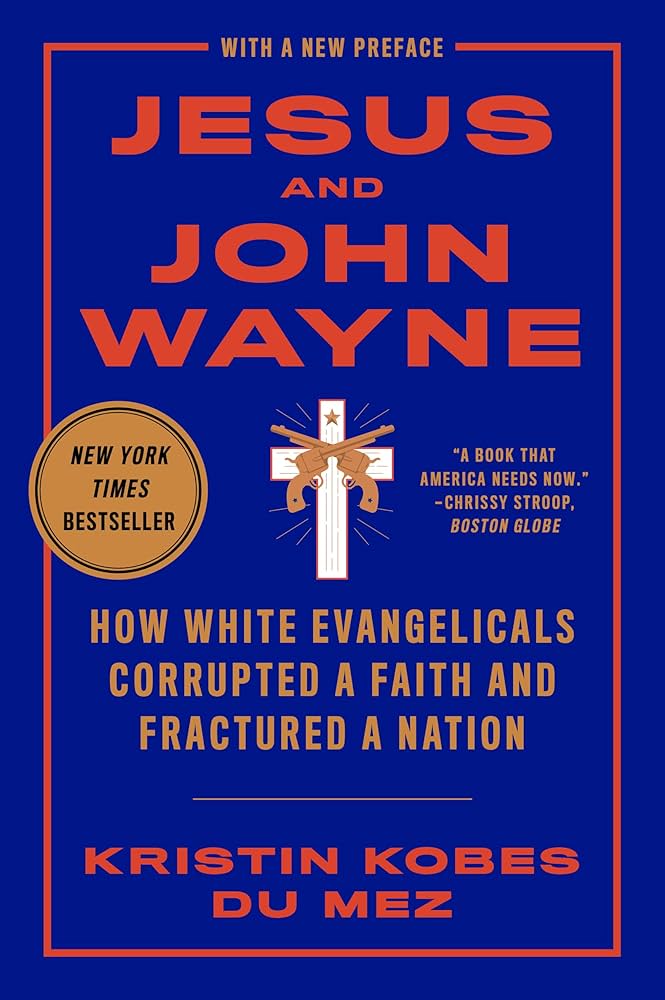
In an interesting deep dive into the history of Christianity over the past seventy years in the United States, Professor Kristin Du Mez’s book, Jesus and John Wayne, is both fascinating and disturbing. As she unravels the journey of evangelical Christianity we are presented with the roots and reasons for the appeal and adoration of a figure such as Donald Trump. Without Christian evangelical support he would never have risen to power, or repeated his comeback.

The past 50 years have seen a rise in the person of Jesus portrayed as a masculine warrior, morphed into American military heroes and Hollywood cowboys. Male leadership, patriarchal worldviews, distinctive gender roles with women in the home and unquestionably submissive to men, have been some hallmarks of the evangelical Christian movement. Disturbed by the rise of liberal worldviews the tone has been stridently anti: anti abortion, anti gay, anti women in leadership, anti Islam, anti the feminism of men, anti peace and tolerance. Their antidote is a militaristic strong arm wielded to assert Christian values, Biblical teaching, and the exercise of legislative muscle to ensure adherence to their perceived American Christian identity. The end justifies the means; which is why Trump is far more attractive as a flawed masculine leader, than Clinton or Obama as soft, liberal, flawed leaders. Hillary Clinton and Kamilla Harris had no chance merely because they were women.
Christians have a tendency to pontificate about ‘us and them’ in a somewhat self-righteous manner. If we are serious about truth, then we need to admit to the reality of shortcomings under the guise of Christianity, blind spots, and even heretical interpretations of Biblical teachings. I don’t believe that Christians and government have the mandate, or the right, to impose their worldview upon others. Jesus never did that. If anything, Christian government should create a safe place for all to grow and mature, whether I/we agree with choices and lifestyles, or not.

Jesus warned humans about judging one another, and assuming too much authority over others. Giving people space to be different, and perhaps to grow, does not imply agreement, or even approval.
Here is another story Jesus told: “The Kingdom of Heaven is like a farmer who planted good seed in his field. But that night as the workers slept, his enemy came and planted weeds among the wheat, then slipped away. When the crop began to grow and produce grain, the weeds also grew.
“The farmer’s workers went to him and said, ‘Sir, the field where you planted that good seed is full of weeds! Where did they come from?’
“‘An enemy has done this!’ the farmer exclaimed.
“‘Should we pull out the weeds?’ they asked.
“‘No,’ he replied, ‘you’ll uproot the wheat if you do. Let both grow together until the harvest. Then I will tell the harvesters to sort out the weeds, tie them into bundles, and burn them, and to put the wheat in the barn.’” (Matthew 13:24-30)
It seems to me when one has lost the revelation of Jesus as embodied in his character and teaching, and forfeited a personal relationship with him empowered by his Spirit, then all that remains is a shell (an empty vessel) bellowing hollow doctrine, dogma, and the last resort of rules and regulations. Which is exactly how the Pharisees abused their status and power and goaded the Jews of Jesus’ day into submission. He challenged them to no avail, and was eventually crucified as a consequence of their attitudes, convictions, and blindness.

There was an ominous warning given by Jesus before his death and resurrection.
Not everyone who says to me, ‘Lord, Lord,’ will enter the kingdom of heaven, but the one who does the will of my Father who is in heaven. On that day many will say to me, ‘Lord, Lord, did we not prophesy in your name, and cast out demons in your name, and do many mighty works in your name?’ And then will I declare to them, ‘I never knew you; depart from me, you workers of lawlessness.’ (Matthew 7:21-23)
A short quote from the book:
……for many evangelicals, Donald Trump did not represent the betrayal of many of the values they had come to hold dear. His testosterone-fueled masculinity aligned remarkably well with that long championed by conservative evangelicals. What makes for a strong leader? A virile (white) man. And what of his vulgarity? Crudeness? Bombast? Even sexual assault? Well, boys will be boys. God-given testosterone came with certain side effects, but an aggressive and even reckless masculinity was precisely what was needed when dealing with the enemy. If you wanted a tamer man, castrate him. Among those who embraced this sort of militant masculinity, such character traits paradoxically testified to Trump’s fitness for the job. Some white evangelicals did end up “holding their nose” to vote for Trump, but for many, he was exactly what they had been looking for. Or at least close enough. Some stated this explicitly; for others, the affinities were apparent in the language they used to explain or excuse their support for Trump. He was strong, he wouldn’t bow to political correctness, he was their “ultimate fighting champion.”
Du Mez, Kristin Kobes ; Kobes Du Mez, Kristin. Jesus and John Wayne: How White Evangelicals Corrupted a Faith and Fractured a Nation (pp. 268-269). Liveright. Kindle Edition.
I strongly encourage you to read the book and/or listen to the interview with the author (see below). It is an illustration of how seemingly good and godly values and people can be stitched into a Christian collage that so easily distorts God’s revelation of love through Jesus. One thing leads to another, and before long the Bible is wrapped in the national flag, whether USA, Israel, or any other. God has no favorites! (repeat, repeat, repeat)
Although the evangelical cult of masculinity stretches back decades, its emergence was never inevitable. Over the years it has been embraced, amplified, challenged, and resisted. Evangelical men themselves have promoted alternative models, elevating gentleness and self-control, a commitment to peace, and a divestment of power as expressions of authentic Christian manhood. Yet, understanding the catalyzing role militant Christian masculinity has played over the past half century is critical to understanding American evangelicalism today, and the nation’s fractured political landscape. Appreciating how this ideology developed over time is also essential for those who wish to dismantle it. What was once done might also be undone.
Du Mez, Kristin Kobes ; Kobes Du Mez, Kristin. Jesus and John Wayne: How White Evangelicals Corrupted a Faith and Fractured a Nation (p. 304). Liveright. Kindle Edition.




 Googling God
Leave a comment