
There’s much chatter about ‘pardons’ right now.
The Cambridge Dictionary states that to pardon means to forgive someone for something they have said or done.
Hence the question mark, the exclamation, and the period in this title.
Is the giving and receiving a pardon a request, an entitlement, or something in between?
Christianity presents ‘the pardon’ as one of the most exquisite and precious gifts ever offered to humanity. It began with a relational breakdown between humanity and God. On the one hand, human beings discovered they frequently made wrong choices, got into trouble, wished they hadn’t taken that action, and regretted not listening to directives the first time. They experienced shame, guilt, and failure. Fig trees were barren after every leaf had been ripped off to cover nakedness and exposure. They were begging for pardons.
God looked on with understanding and compassion at his creation, embroiled in attitudes and actions so foreign to his desire or intent. Free will, the most dangerous of gifts, was almost immediately misappropriated.
God’s prerogative was to pardon. He had already warned what would happen when men and women took life/matters into their own hands. If they chose whatever appeared fun at the moment—to hell with the consequences because it seemed good, felt good, and garnered popularity.
Justice under God rested on truth-telling. Consequences inevitably followed every action, good or bad, neutral, indifferent, or intentional.
Initially, sacrifices were initiated by God as humans requested pardons/forgiveness. They would offer an animal as a sign of their recognition of culpability. The blood sacrifice was an outward sign of their heart’s desire to make things right. However, animal sacrifices were limited in their efficacy with no power to impact and change the source of rebellion, the hearts and minds of the guilty ones.
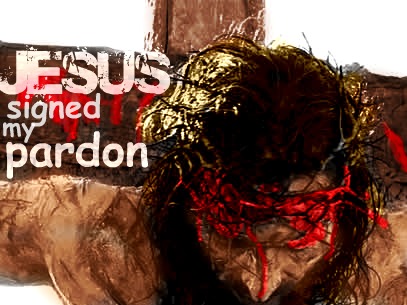
The greatest gift and cost of the ultimate pardon was the life, death, and resurrection of Jesus. When he hung on the Cross, Jesus died under judgment for all my ‘sins/wrongdoings’. The penalty for rebellion is death. Death of a relationship, death of hope, death of a softening of heart, death of a change of mind. The guilty one did not deserve a pardon, was not entitled to one, and was powerless, entirely at the mercy of the one he/she had offended, betrayed, or rebelled against.
God so loved the world that his priceless gift was his Son, whose suffering and death made possible my pardon, restoration, receiving of grace and mercy, and having multiple second chances. It’s by no means my right and is not unconditional. I only receive God’s pardon through Jesus when I acknowledge my wrongdoing. Forgiveness flows when I admit that I am powerless to change (as the AA foundation principles underscore).
The pardon is never activated by the one who offers the pardon. It is a response to one needing a pardon, admitting their unlawful action, having a change of heart, and leaning into the mercy of the one they have offended.
The pardons we have witnessed over the past weeks south of the border are a total misrepresentation of God’s grace and mercy. They are convenient, expedient, political, and entirely watered-down versions of God’s truth and grace. They cost nothing and demand nothing. Sadly, humans invariably take what God initiated in truth and love and disfigure the gift into an ugly weapon to beat on some and favour others.
God invites all of us to come to him without fear. He does not take our wrongdoings to use against us, to seek revenge, or to beat us up. We do that enough (usually) ourselves. Neither does he invite us to come as we are without the intent or desire to be changed and perhaps become more as he created us to be. There is only room for one God, one Way, one Truth, and One life. Unconditional love embraces all we bring but never condones all we are or have become in our rebellious wanderings.
God’s love and pardons provide a gateway to new beginnings, deeper revelations, reconciliation, and unmerited and undeserved restoration. That’s the meaning of grace and mercy. They are gifts to be cherished, handled with prayer, and delighted in—as refreshing as a cleansing shower on a mud-caked body.
Receiving God’s forgiveness and pardon renders me speechless, filled with gratitude, and even singing songs of worship. It opens my heart and mind to being made new, better, braver, more truthful, kinder, more aware, and deeply compassionate to my fellow pilgrims.
Only those who have experienced God’s pardon can ever pass it on to others with no strings attached. With joy in the giving and hope fulfilled in the one receiving.

Let’s not settle for pardons made in China, America, Canada, England, or elsewhere. It’s the pardon from heaven that transforms people on earth. The pardon released through the blood of Jesus touches heart and mind, enables the deaf to hear, the blind to see, the lame to walk, the stone heart to melt into flesh, the fist to unfold, and even the dead to rise up and breathe new life. It far transcends politics, nations, and personal agendas.
Pardon me?
I asked God? Not entitled at all. He did, will, and does pardon! The real thing.



 Googling God
Leave a comment